

Limitation Periods For Legal Claims in NZ

Nathan Tetzlaff | September 14, 2021

If you have a legal claim against someone, the law requires that you take legal steps to pursue it within a certain period.  If you don’t, that claim cannot proceed.  This is known as the limitation period.

The purpose of limitation periods is to prevent a situation where somebody has a claim against them held over their head indefinitely.  This also promotes the prompt application of justice.

Limitation periods apply to both criminal proceedings and civil proceedings.  There are very few wrong-doings which do not have a limitation period.  The most notable crime where there is no limitation period is murder.

Civil Claims

In civil claims the obligation is on the wronged person to take steps to enforce their rights against the wrongdoer.  The government does not typically get involved.  It is important for people to know what limitation periods might apply, and how to avoid having these expire before you seek justice.

In a civil claim, the expiry of a limitation period is a defence if the claim is filed in court after the limitation period expires.  Filing the claim within the limitation period is acceptable, even if the claim is not resolved before that period expires.  Often, claims will be filed in court a week or even a day before the expiry of a limitation period just to prevent the loss of the claim.  This can act as a strong incentive on a person to get around to pursuing their rights.

Extensions

Some limitation periods may be extended in certain circumstances.  The Limitation Act refers to a “late knowledge date”.  For example, if a person was reasonably not aware that the wrongdoer had done the act, was not aware that the act had caused loss to them, or did not know who the wrongdoer was, then the late knowledge date provision may apply.  This can extend the limitation period for a certain amount of time, although a long-stop may apply.  The long-stop is a maximum limitation period, and even the late knowledge extension cannot extend the claim beyond the long-stop date.

Different types of claims have different limitation periods

There are quite a few different limitation periods for civil claims. The below is not an exhaustive list but gives you an indication of the types of limitation periods that exist.

Money claims

For money claims (such as breach of contract or damages for negligent losses) the ordinary limitation period is 6 years from when the cause of action arose.  This is usually, but not necessarily, the date that the person did the thing which cause the loss, such as breaching the contract.  The late knowledge extension is 3 years, with a 15 year long-stop.

Defamation

For a defamation claim the limitation period is much shorter.  Defamation has a 2 year limitation from the time that the defamatory statements were made, with a 2 year possible late knowledge extension.

Recovery of goods and enforcement of judgment

For recovery of goods or enforcement of a judgment the limitation period is 6 years from when the goods were taken, or the judgment was made.

Construction and building

In construction, the limitation period is 6 years with a possible late knowledge extension of 3 years.  There is a reasonably short long-stop of 10 years.

Limitation periods have had a lot of impact in the construction industry. This is because a construction project may take several years, and it may be difficult to notice that construction has not been done properly until years after that.  As a result of this, claims are often filed in Court at or near the expiry of the limitation period.  Also, it may not be entirely clear when the limitation period started from.

Consider a situation where:

  1. A builder negligently lays the foundations of a building in February 2010;
  2. The building is only completed, and council consent granted, in February 2011; and
  3. The owners only move into the building in 2012;
  4. The owners notice some shifting and cracking in the walls and door frames in January 2019;
  5. After having an expert assess the shifting and cracking and finding out about the builder’s negligence, the owners file a case in court in January 2021.

In that case the owners have filed the proceedings outside of the usual six-year limitation period. They would need to argue that the 3-year late knowledge extension applies to them and would have to show that they should not reasonably have discovered the builder’s negligence earlier.

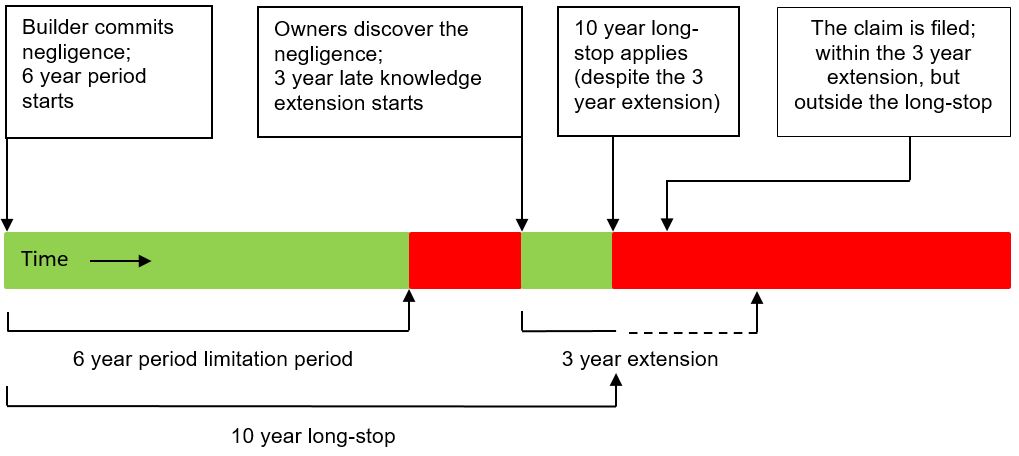
However, the 10 year long-stop would be a problem for them. The owners might argue that they are within a 10 year period from when the building was completed, but the builder might argue that the 10 year period should start running from when he did the work.  On a timeline where the green bar is when a claim can be filed, and the red bar is when it is outside the limitation period, the situation looks like this:

Timeline showing periods: green

These issues have been discussed in various Court cases, and the current state of the law is that both the limitation period and long-stop start running at the point the liable person does the work, not from the point that the total project is completed.  In this hypothetical case the owners may still have a claim against the council for issuing a building consent for a negligently constructed building, as the claim was filed within 10 years from the date that the council building consent was granted.

Limitation periods can have enormous significance and may not always be straightforward.  If you think you have a legal claim, we recommend that you talk to us a soon as possible to avoid any risk of a limitation period expiring and your claim being out of time.

Loading author information...

Get In Touch

Read More Articles

Brown and white brick building with tower, under blue sky.
By Mikayla Sagar February 15, 2026
Probate vs. Letters of Administration
Wedding rings on divorce papers as someone signs; blue and white.
By Natalie Miller February 6, 2026
Most people think prenups are something celebrities sign before a whirlwind wedding. But in New Zealand, a contracting out agreement is far more common, far more practical and, for many couples, essential. Under the Property (Relationships) Act 1976 (“Act”), the guiding principle is that all relationship property should be shared equally when a de facto relationship, civil union, or marriage ends. There are certain exceptions – as always. The only way to avoid the presumed 50/50 sharing regime is to contract out of the Act. That is exactly what a contracting out agreement does. If the agreement meets the legal requirements, it allows couples to decide for themselves how their assets and liabilities will be divided if the relationship ends through separation or death. What happens if you don’t have one?  If you are in a qualifying relationship and don’t have a contracting out agreement in place, most of what you own or owe could be divided equally if you separate or if one partner dies. Think you are safe because the asset is in your sole name or was gifted to you? Think again. In certain circumstances these types of property could still be up for equal division. Why you should seriously consider one For many people, the primary motivation is protection. A contracting out agreement can ring fence specific assets so they remain your separate property, such as a home you purchased before the relationship or savings you built independently. It can also ensure you do not become responsible for your partner’s debt, such as a student loan or personal liabilities that you had no part in creating. Just as importantly, a contracting out agreement sets clear expectations for how newly acquired assets and debts are owned and managed during the relationship and what will happen to those if the relationship ends. By defining everything upfront, the agreement can prevent confusion, conflict and costly disputes later. When can you get a contracting out agreement? A contracting out agreement can be put in place at almost any stage. Some couples arrange one at the very beginning of a relationship. Others do it after buying a home together, having children or blending finances. It is also possible to enter into one at the end of a relationship. However, the safest and cleanest approach is to get one as early as possible, ideally before the relationship becomes a qualifying relationship or before either partner acquires rights under the Act.
Two pairs of hands clasped together, suggesting support and comfort.
By Kimberley Brown February 6, 2026
Writing your own Will or using a DIY Will Kit may seem like an easy and cost-effective option. However, while a homemade or online Will may appear to save money upfront, it will often cause major complications and costs in the long run. Learn why getting legal advice ensures your Will is valid, effective, and truly reflects your wishes.
Hand holding a notepad with
By Kimberley Brown February 5, 2026
Even a small error in your Will can cause significant delays and unnecessary expenses once it reaches the High Court for Probate.